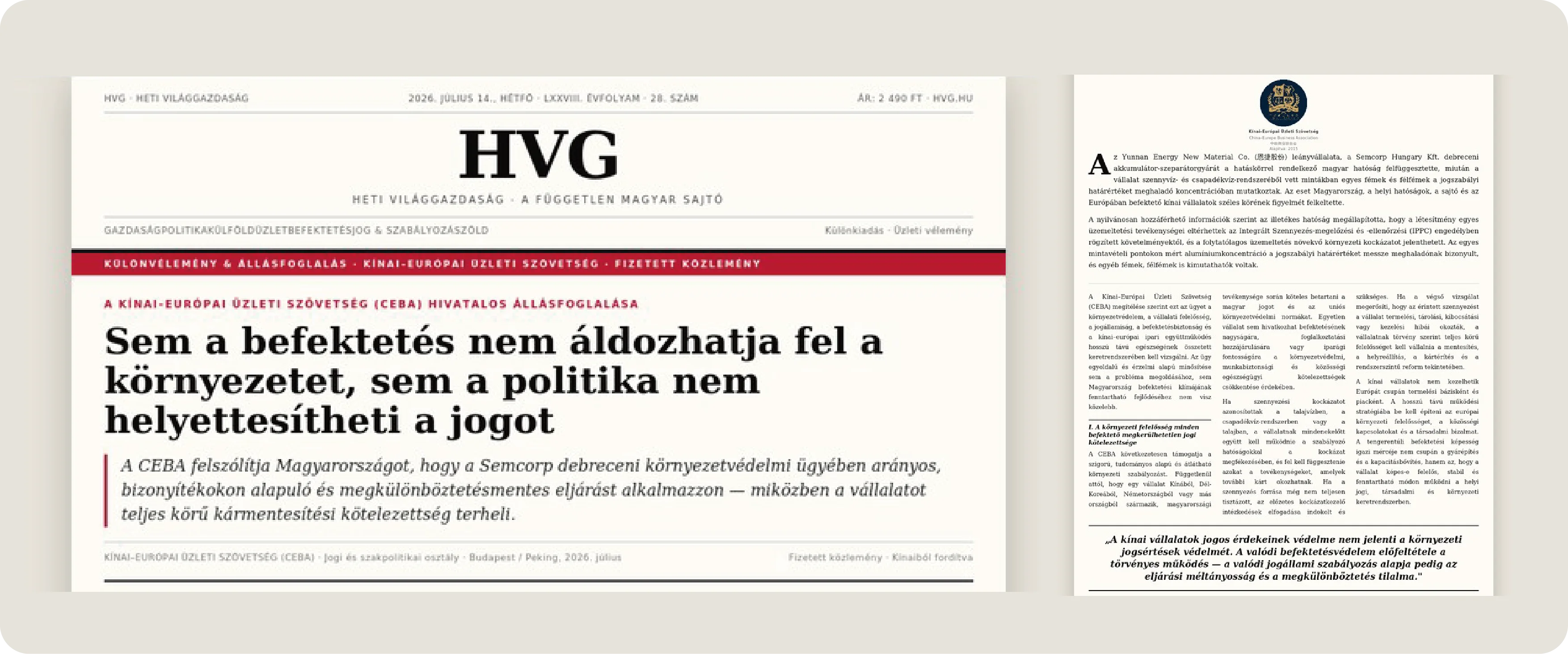
——Observations and Recommendations by China-EU Business Federation on SEMCORP Group’s Environmental Incident at Its Hungarian Plant
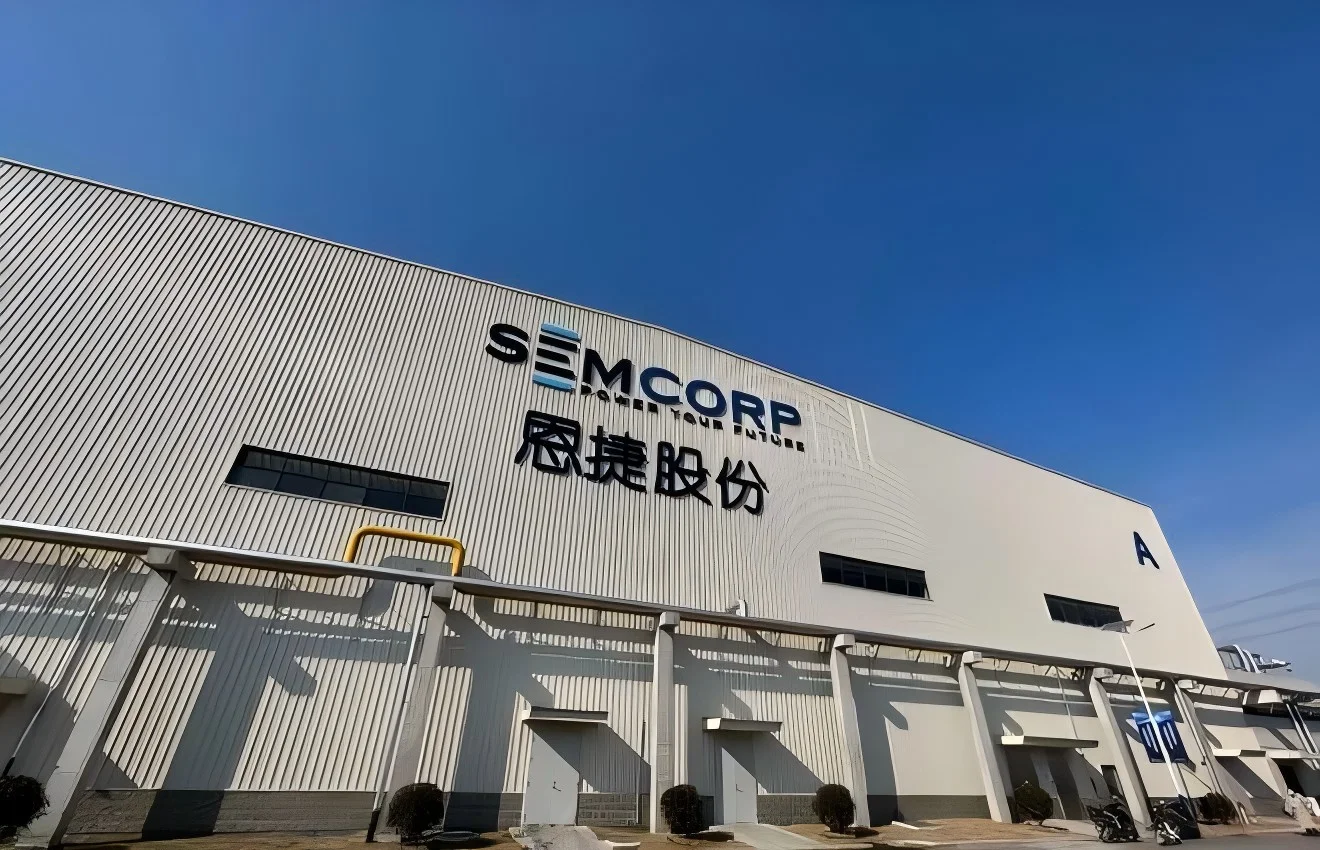
Recently, SEMCORP Hungary, a subsidiary of SEMCORP Group operating a lithium battery separator plant in Debrecen, Hungary, was ordered by local competent authorities to suspend production after tests detected concentrations of certain metals and metalloids exceeding statutory limits in groundwater and the site’s drainage systems. The incident has drawn widespread attention from the Hungarian government, local communities, media and Chinese business circles in Hungary.
Based on publicly available information to date, Hungarian competent authorities hold the view that some operational activities of the plant may deviate from requirements stipulated in its Integrated Pollution Prevention and Control permit, and continued operation could escalate environmental risks. Consequently, a decision was made in late June 2026 to suspend relevant production activities. Test results showed aluminium levels at individual sampling points far above legal thresholds, alongside detections of other metals and metalloids. Local government and environmental authorities have launched further investigations and pollution remediation procedures.
SEMCORP Hungary has stated that the company is complying with requirements from competent authorities and cooperating with on-site inspections, environmental sampling and submission of technical documentation. The company also notes that technical questions remain to be clarified regarding the exact sources of some detected substances, and several heavy metals are not directly utilised in its separator production processes. The enterprise expressed readiness to bear corresponding liabilities for environmental impacts ultimately confirmed to stem from its operational activities, on the basis of scientific investigations and legal proceedings.
The China-EU Business Federation believes this incident should be examined under a multi-faceted framework encompassing environmental protection, corporate accountability, law-based administration, investment security and China-EU industrial cooperation. Any one-sided emotional characterisation will not facilitate resolution of the issue, nor will it benefit Hungary’s long-term investment climate and the sound development of China-EU economic and trade ties.
I. Environmental Protection Constitutes an Unavoidable Legal Obligation for All Investing Enterprises
The China-EU Business Federation consistently supports rigorous, scientific and transparent environmental regulation.
Regardless of whether enterprises originate from China, the Republic of Korea, Germany or other countries, all entities operating within Hungary must abide by Hungarian legislation and EU environmental standards. No enterprise may cite investment scale, employment contributions or industrial importance as grounds to lower its responsibilities concerning environmental protection, occupational safety and community health.
Where risks of contamination to groundwater, rainwater systems or soil have been identified, enterprises shall first cooperate with regulators to contain risks, halt operations that may cause further harm, and safeguard local residents’ health and ecological security. Before pollution sources are fully verified, adoption of necessary interim risk control measures is reasonable and imperative.
If final investigations confirm that relevant pollution arises from the enterprise’s production, storage, discharge or improper management, the company shall bear statutory liabilities for remediation, restoration, compensation and rectification, and systematically review its environmental management system.
Chinese enterprises going global cannot regard Europe merely as a production base and market. They must integrate environmental responsibilities, community relations and social trust into long-term operational strategies. The true competence of enterprises investing overseas lies not only in factory construction and capacity expansion, but also in their capacity to operate sustainably, steadily and responsibly within local legal, social and environmental frameworks.
II. Environmental Data Must Be Validated Through Independent, Comprehensive and Verifiable Scientific Investigations
Support for stringent regulation does not equate to pre-emptively attributing all pollution to a single enterprise before facts are fully established.
Public information indicates relevant samples were collected from monitoring wells, rainwater drainage systems, reservoirs and zones connected to the incident. Severely exceeding test readings demand high attention. Nevertheless, the source of pollutants, migration pathways, timeline of contamination, interconnections between different industrial facilities, as well as variations between historical environmental baselines and current data require confirmation via comprehensive environmental sampling, third-party testing and technical source tracing.
The southern industrial zone of Debrecen hosts multiple industrial enterprises. Given the concurrent detection of diverse metals and metalloids, competent authorities should systematically investigate groundwater flow directions, pipeline networks, historical land use, emissions from surrounding enterprises, construction activities and existing pollution sources across the entire industrial zone.
The Debrecen Municipal Government previously stated that following the incident in February 2026, local rainwater drainage systems were closed, associated water storage facilities were deployed to isolate potentially contaminated rainwater, and competent authorities launched investigations into the scope and potential spread of pollution.
Accordingly, the China-EU Business Federation recommends that Hungarian competent authorities take the lead in engaging independent laboratories and environmental engineering institutions holding EU accreditation, free of conflicts of interest with both the government and the enterprise, to conduct a second round or multiple parallel testing campaigns. Investigations should cover locations inside and outside the plant site at varying depths and different time points, with public disclosure of testing methodologies, sample preservation protocols, laboratory qualifications and pollution source tracing models.
Only investigation conclusions built on complete chains of evidence can genuinely protect the environment and prevent partial data from being directly turned into political judgements lacking sufficient substantiation.
III. Enterprises Shall Bear Liabilities, Yet Must Not Be Prejudged Guilty Prior to Completion of Judicial and Administrative Procedures
In the wake of this incident, several politicians and local officials have made stark public statements, including demands for the enterprise to leave the locality and calls for long-term factory shutdowns. The Hungarian government has also announced consideration of establishing a new environmental regulatory authority and potential tightening of penalties targeting the battery industry.
It is the statutory duty of governments to impose strict measures against environmental violations. Nonetheless, administrative regulation must adhere to facts, laws, procedures and the principle of proportionality.
Before pollution sources, the extent of the enterprise’s fault and resultant damages are confirmed through full investigations and requisite legal procedures, government officials should refrain from publicly pronouncing the enterprise’s ultimate fate using political rhetoric. Administrative authorities may suspend production activities posing tangible environmental risks. However, decisions on permanent closure, permit revocation or mandatory market exit shall be made in accordance with final investigation outcomes, feasibility of rectification, nature of violations and relevant legislation.
While subject to regulation, enterprises legally enjoy rights to statement, defence, evidence access, application for review and judicial remedy. Regulators must neither grant leniency due to an enterprise’s standing as a major investor, nor apply harsher political standards solely because the enterprise is Chinese-owned.
The China-EU Business Federation supports Hungary’s law-based strengthening of environmental supervision, yet opposes the nationalisation and politicisation of a single corporate incident, and rejects turning routine environmental law enforcement into a trial by public opinion targeting investors from a specific country.
IV. Adjustments to Hungary’s Regulatory Policies Must Maintain Continuity, Transparency and Non-Discrimination
Hungary has actively developed the new energy vehicle and power battery industries in recent years, attracting substantial investment from China, the Republic of Korea and other nations. Public statistics show that since 2021, Hungary has drawn approximately EUR 26 billion of foreign investment along the battery and new energy vehicle industrial chains, evolving into a pivotal new energy vehicle industrial hub in Europe.
Numerous enterprises made long-term investment decisions based on industrial policies, investment agreements, land planning, environmental permits and fiscal support previously announced by the Hungarian government. While new administrations retain the right to adjust regulatory policies in response to social demands and environmental risks, such adjustments should uphold legal continuity and predictability.
New environmental standards shall in principle apply uniformly to all enterprises, rather than targeting only Chinese firms or foreign-invested companies. New fine regimes, environmental permit criteria and regulatory bodies should clearly specify effective dates, scope of application, transition periods for rectification and appeal mechanisms to avoid retrospective enforcement of standards not yet in force.
For projects that have obtained permits and completed substantial investment, if enterprises can eliminate environmental risks through technical retrofits, equipment upgrades and management improvements, governments should prioritise offering clear, executable rectification pathways instead of treating permanent shutdown as the sole policy instrument.
A stable, transparent and non-discriminatory regulatory environment bears implications not only for Chinese enterprises, but also for Hungary’s long-term credibility among all international investors.
V. The China-EU Business Federation Proposes Establishment of a Quadripartite Joint Response Mechanism
To swiftly ascertain facts, contain environmental risks and restore public trust, the China-EU Business Federation suggests forming a joint response mechanism comprising Hungarian competent authorities, the Debrecen local government, the enterprise and independent third-party representatives.
Immediately conduct an independent environmental auditCarry out comprehensive testing of groundwater, soil, rainwater drainage systems, production equipment, raw materials, wastewater treatment facilities and the incident site, and develop a pollution source tracing model. Test results shall undergo cross-verification by independent laboratories to avoid conclusions drawn merely from individual samples or single time-point measurements.
Formulate phased environmental remediation plansRegardless of the final allocation of pollution liabilities, the enterprise shall prioritise curbing pollution spread under the guidance of competent authorities, including isolation, pumping, treatment and continuous monitoring of affected zones. Equipment, pipelines and management links open to immediate improvement should be rectified expeditiously.
Set up a transparent information release mechanismCompetent authorities and the enterprise shall regularly share test data, rectification progress and health risk assessments with local residents. Information disclosure should adopt accessible language for the general public; risks must not be downplayed, nor unconfirmed conclusions exaggerated.
Clarify conditional production resumption criteriaThe government shall provide the enterprise with a written rectification checklist, acceptance benchmarks and conditions for resuming production. Once the enterprise completes rectification, eliminates risks and passes independent acceptance, it shall be lawfully permitted to restart compliant production activities. Enterprises should not face indefinite production suspension without clear standards, deadlines or pathways to resume operations.
Establish community communication and public oversight mechanismsThe enterprise shall set up a local community liaison office and invite residents, environmental organisations, experts and trade union representatives to regular consultations. Reasonable public concerns regarding environment and health should be addressed proactively rather than handled passively only via legal and public relations channels.
Boost compliance capacity building for Chinese enterprises operating in EuropeChinese enterprises establishing manufacturing facilities in Europe should build environment, health and safety (EHS) management systems independent of production departments, and engage local management teams proficient in Hungarian law and EU regulatory requirements. Key environmental data shall be reported directly to group boards of directors or audit committees to prevent overseas sites from suppressing risk reporting in pursuit of output and schedules.
VI. We Urge the Hungarian Government to Protect the Legitimate Rights and Interests of Chinese Enterprises in Accordance with Law and Fairness
The China-EU Business Federation solemnly calls upon the Hungarian government and relevant competent authorities to protect Chinese enterprises investing and operating in Hungary in a lawful, impartial and non-discriminatory manner, while safeguarding the environment and residents’ health in accordance with legislation.
We expect the Hungarian government to implement the following measures:
Reach administrative decisions strictly based on evidence and law, and refrain from substituting factual investigations with political stances, public sentiment or corporate nationality;
Guarantee enterprises full rights to statement, defence, administrative review and judicial remedy;
Apply unified environmental and safety standards to enterprises from China, the Republic of Korea, Europe and other countries;
Define clear implementation rules and reasonable transition periods for new regulatory regimes and avoid arbitrary retrospective enforcement;
Provide clear, predictable pathways for production resumption in law once enterprises complete rectification and meet statutory standards;
Discourage individual officials from releasing pre-emptive, exclusionary or nationality-targeted public remarks prior to conclusion of investigations;
Continue honouring policy and legal commitments made by the Hungarian government to lawful foreign investment, and preserve continuity of the investment climate alongside international credibility.
Protecting the legitimate rights and interests of Chinese enterprises does not equate to defending environmental violations. On the contrary, genuine investment protection presupposes law-abiding operation, and genuine law-based regulation must be grounded in procedural fairness and the non-discrimination principle.
The China-EU Business Federation appeals to the Hungarian government: the environment should not be sacrificed for investment, nor law replaced by politics.
The incident at SEMCORP Group’s Hungarian plant delivers an important reminder to Chinese enterprises, the Hungarian government and China-EU industrial cooperation alike.
Chinese enterprises must recognise that investment in Europe has entered an era of in-depth localisation. Companies need to build not only production capacity, but also environmental accountability, public trust and stakeholder communication capabilities. Any underestimation of environmental risks may ultimately translate into substantial operational, brand and political risks.
The Hungarian government likewise needs to acknowledge that environmental governance and investment protection are not contradictory. Rigorous environmental regulation helps improve industrial quality, yet regulation must be law-based, transparent, stable and non-discriminatory. Penalising corporate violations in accordance with law and protecting enterprises’ legitimate investment rights can and should proceed in tandem.
The China-EU Business Federation supports Hungary’s law-based investigation and remediation of environmental pollution, and supports SEMCORP Group in cooperating with investigations, disclosing facts, assuming liabilities and carrying out rectification in accordance with law. At the same time, we oppose politicised and nationality-based judgements targeting Chinese enterprises before all facts are ascertained.
The foundation of China-EU industrial cooperation should rest neither on unconditional investment incentives nor emotional exclusion, but on shared compliance with law, joint environmental stewardship, mutual respect for investment and shared accountability.
Long-term, stable and sustainable development of China-EU green industrial cooperation can only be realised when environmental safety is secured, corporate rights are respected and regulatory procedures remain impartial.
China-EU Business Federation
July 2026